
What Is Epoxy Flooring?
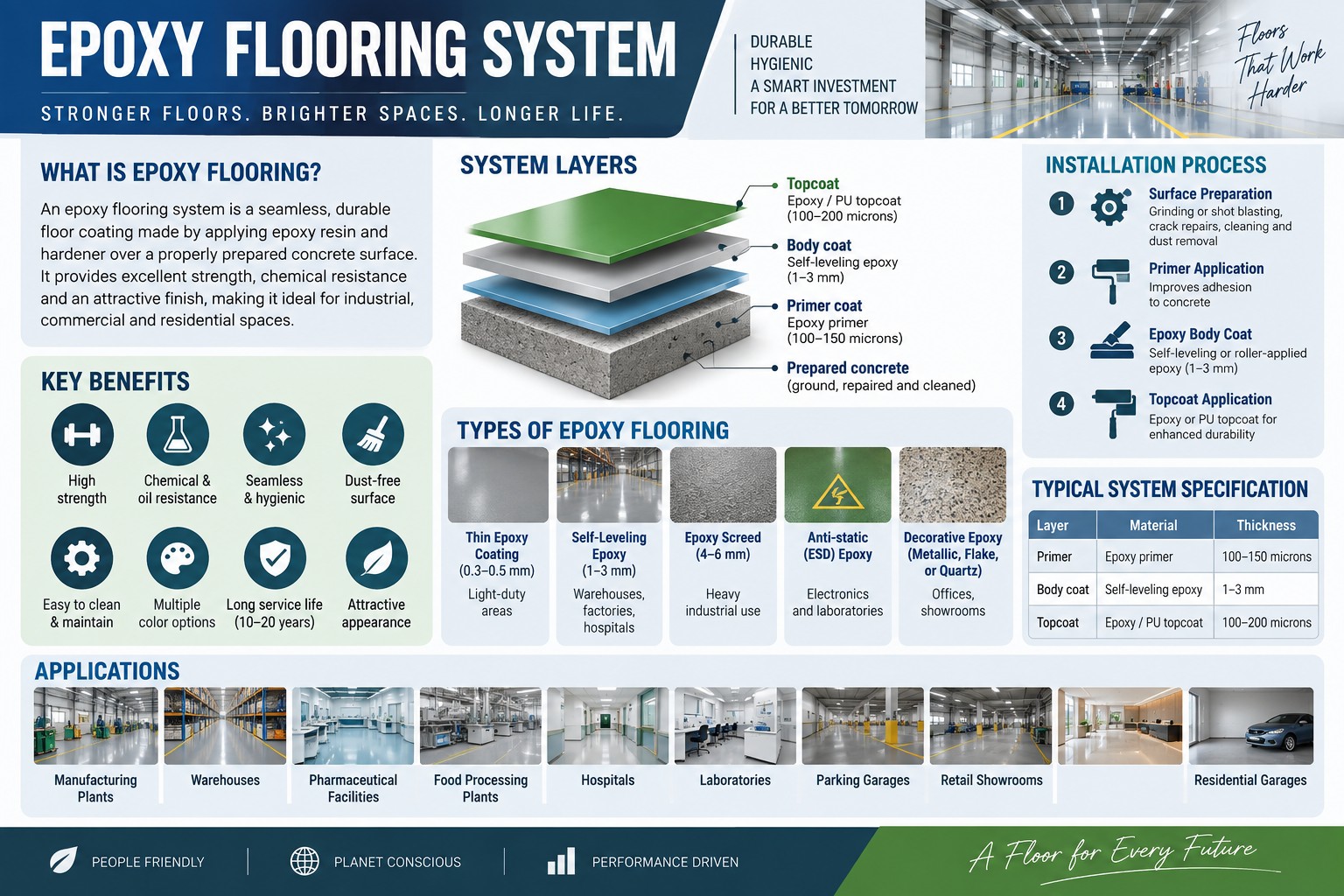
An epoxy flooring system is a seamless, durable floor coating made by applying epoxy resin and hardener over a properly prepared concrete surface. It is widely used in industrial, commercial and residential buildings because it provides excellent strength, chemical resistance and an attractive finish.
Typical Epoxy Flooring System
1. Surface Preparation
Grinding or shot blasting of concrete, crack and joint repairs, cleaning and dust removal.
2. Primer Coat
Improves adhesion to the concrete substrate.
3. Epoxy Body Coat
Self-leveling or roller-applied epoxy. Thickness typically ranges from 0.5 mm to 5 mm, depending on the application.
4. Topcoat
Epoxy or polyurethane (PU) topcoat for enhanced abrasion, UV and chemical resistance.
Types of Epoxy Flooring
- Thin epoxy coating (0.3-0.5 mm): Light-duty areas
- Self-leveling epoxy (1-3 mm): Warehouses, factories and hospitals
- Epoxy screed (4-6 mm): Heavy industrial use
- Anti-static (ESD) epoxy: Electronics and laboratories
- Decorative epoxy: Metallic, flake or quartz finishes for offices and showrooms
Advantages
- High mechanical strength
- Excellent chemical and oil resistance
- Seamless and hygienic
- Dust-free surface
- Easy to clean and maintain
- Attractive appearance with multiple colour options
- Long service life, typically 10-20 years with proper maintenance
Common Applications
Manufacturing plants • Warehouses • Pharmaceutical facilities • Food processing plants • Hospitals • Laboratories • Parking garages • Retail showrooms • Residential garages
Typical System Specification
For a specific warehouse, pharmaceutical plant, food factory, parking area or residential garage, HKS Surfaces can recommend the appropriate system thickness and specification.
| Layer | Material | Thickness |
|---|---|---|
| Primer | Epoxy primer | 100-150 microns |
| Body coat | Self-leveling epoxy | 1-3 mm |
| Topcoat | Epoxy/PU topcoat | 100-200 microns |